



I never knew I needed a telephoto lens until now. As a traveler, I always thought that, with a combination of the Sony 16-55mm F2.8 lens and the Rokinon 12mm F2, it should cover all the ranges I need for most applications. However, when I got my hands on the Sony E 70-350mm F4.5-6.3 lens (SEL70350G), it completely changed my perspective on telephoto lenses for travel. Now, I can't travel without it.
The Sony E 70-350mm F4.5-6.3 lens is a compact super-telephoto lens released in 2019 specifically for Sony APS-C cameras. The focal lengths you get from this lens are equivalent to a whopping 105-525mm on a full-frame-size sensor, and the fact that it is light and compact makes it even more outstanding.
I got my hands on this lens before I went on a trip to Kanchanaburi in Thailand, and I got to test it out quite a bit. I'm happy to say that the Sony 70-350mm lens has become my favorite lens of all. It is probably one of the best purchases I have made so far this year.
After traveling with the lens for a while now, here is my complete review of the Sony E 70-350mm lens from a traveler's perspective, based on real-world experiences. Continue reading to see my verdict and some sample photos I took with the Sony 70-350mm lens.

Summary of the Sony E 70-350mm F4.5-6.3 Lens
If you are short on time, here is a quick summary of the pros and cons of the Sony E 70-350mm F4.5-6.3 lens, and a link to see the recent price of the lens.
- Light and compact.
- Excellent Weather-Sealed Build Quality.
- Produce Sharp Results
- Fast Autofocus.
- Comes with Optical Stabilization
- Relatively Affordable
- Slow Aperture, Not Great in Low-light
What to look for in a travel telephoto lens?

When it comes to picking a travel telephoto lens, there are four things you should look for before you pick one up: the price, the range it offers, its weight and size, and finally, the sharpness of the lens.
There are cheaper and more compact telephoto lenses available, including the Sony E 55-210mm F4.5-6.3 lens, but image quality and reach are important trade-offs to consider. In my experience, the 55-210mm produced noticeably softer results toward the long end than I get from the 70-350mm.
The key to picking the right telephoto lens is all about the balance between these 4 key points. The price has to be reasonable, the range has to be good, the weight and size have to be light enough for you to carry around when traveling, and finally, it has to produce sharp enough images.
With this understanding, let's look at why the Sony 70-350mm lens meets all the criteria and see how it performs in the field.

Why the Sony E 70-350mm Lens Is the Best Purchase You Can Make For Your Sony APS-C Cameras
Light and Compact

If you are a light traveler like me, every weight you add to your travel load counts, and adding a telephoto lens to your already pretty heavy backpack is not a decision to take lightly. That is probably why I never bothered getting a telephoto lens until now.
With the release of the Sony E 70-350mm F4.5-6.3 lens in 2019, Sony really hit it out of the park with the incredible range-to-weight ratio of this lens. Its 70-350mm zoom range gives you a 105-525mm full-frame equivalent field of view on a Sony APS-C camera, yet the lens measures only 77 x 142mm (3-1/8 x 5-5/8") and weighs 22.1 oz (625 g).

If you compare this lens to a full-frame lens with a similar range, the Sony FE 100-400mm F4.5–5.6 lens, which comes in at 93.9 x 205mm (3-3/4 x 8-1/8") in diameter and length and weighs only 49.3 oz (1,395 g), you start to see how light and compact the Sony E 70-350mm Lens actually is in relation to the reach you get.
That combination of 525mm-equivalent reach and a 625 g body is still one of the main reasons I like the Sony E 70-350mm lens for travel. It gives me serious telephoto reach without requiring the much larger setup I would normally associate with a super-telephoto lens.
Excellent Dust and Moisture Resistant Build Quality
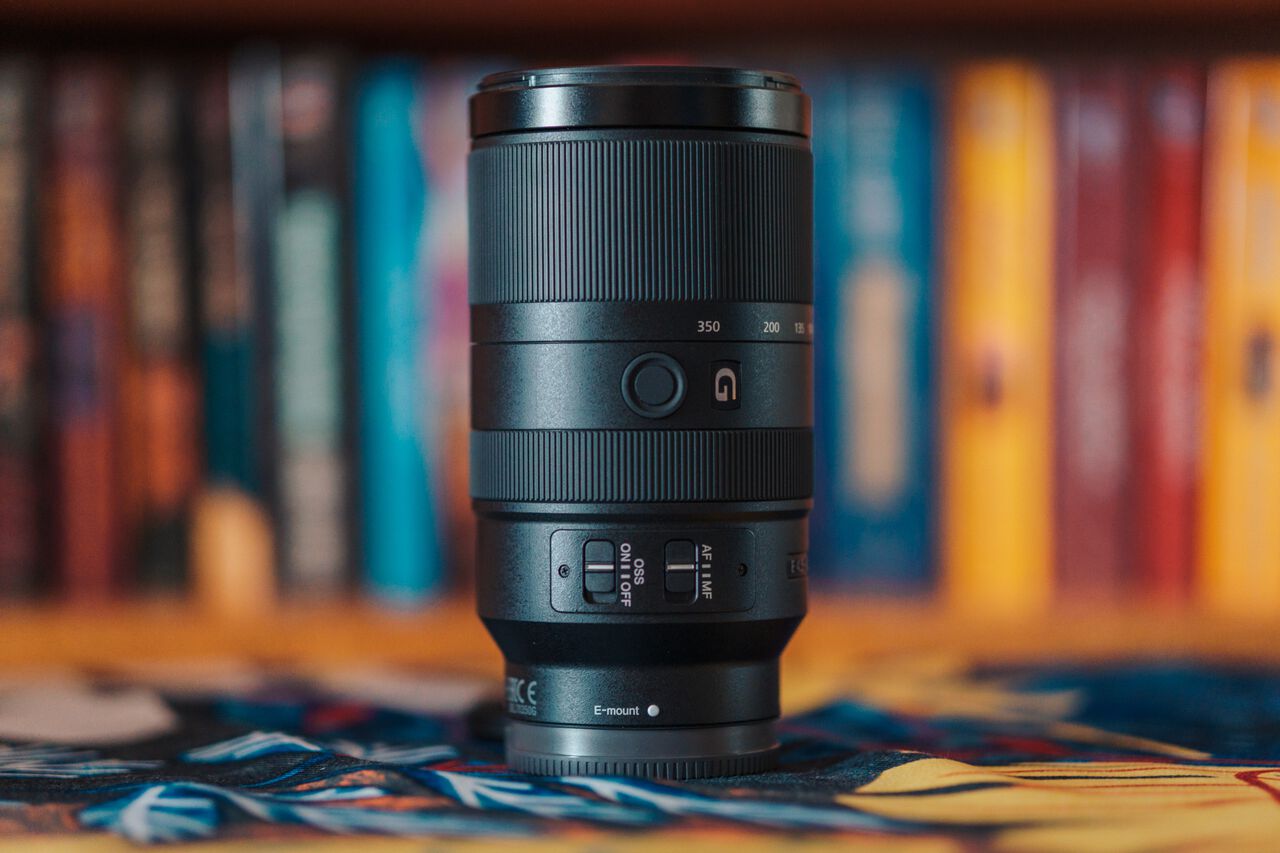
Like the Sony 16-55mm lens, the Sony E 70-350mm F4.5-6.3 lens feels very well built. It has a sturdy body, smooth focus and zoom rings, and a dust- and moisture-resistant design that gives you some extra protection when shooting outdoors.
That does not make the lens waterproof, but the added protection is reassuring when traveling. My copy has been with me on the dusty roads of Bangkok and through rainy weather in Kanchanaburi without giving me trouble, which has made me confident carrying it in less-than-perfect conditions.
Produce Sharp Images

Before I bought this lens, the compact APS-C telephoto I was most familiar with was Sony's 55-210mm. It is smaller and cheaper, but I was never happy with its image quality toward the longest focal lengths.
So when I first pixel-peeped a photo I took with the new Sony E 70-350mm F4.5-6.3 lens at its farthest 350mm focal length, I was surprised to see how sharp it is, especially at the center.

Mind you, the image quality is not as sharp throughout all the focal lengths like the incredible Sony 16-55mm F2.8 lens, but the Sony 70-350mm images are certainly sharp enough to be used professionally, and it definitely blew the old Sony 55-210mm out of the water.

Fast Autofocus

The Sony E 70-350mm F4.5-6.3 lens uses Sony's XD Linear Motor autofocus system, designed for fast, precise, and quiet focusing. In actual use, I have found the autofocus quick and dependable enough for travel and wildlife photography, where subjects often do not stay still for long.
With fast autofocus, you can easily rely on this lens to pick up your subject, and the lens will focus automatically for you, which is incredibly essential for travel or wildlife photography where your subject may or may not stay still for a long period of time. A good autofocus mechanism goes a long way for travel photography, and this lens surely delivers.
Comes with Optical Stabilization

One of the downsides of the previous lens I reviewed, the Sony 16-55mm F2.8, is the lack of optical stabilization. That matters particularly on Sony APS-C bodies without in-body image stabilization, such as the a6400, a6100, and a6000. The 70-350mm has Sony's Optical SteadyShot built into the lens, so you get stabilization regardless of whether your camera body has IBIS.
With the Sony E 70-350mm F4.5-6.3 lens, Sony really went all in and added all the features you would come to expect from a lens released in 2019, including optical stabilization.
Optical stabilization is especially useful on a super-telephoto lens because, at 350mm (525mm full-frame equivalent on APS-C), even small camera movements become much more noticeable. With a maximum aperture of F6.3 at the long end, Optical SteadyShot can also help when you need to use slower shutter speeds for static subjects, although it cannot freeze movement from a moving subject.
So, with the optical stabilization inside the Sony 70-350mm lens, you will have a much better chance of capturing a sharp image, even at the 350mm focal length, than if you use a lens without one.
Relatively Affordable

The Sony E 70-350mm F4.5-6.3 lens launched at $999 USD. Its actual selling price now varies with discounts and retailers, so I recommend checking the current price rather than judging it by the original MSRP.
For the reach, compact size, stabilization, autofocus, and image quality you get, I still think the lens offers a strong balance for travelers who specifically want a long telephoto zoom.
I bought mine second-hand for around $750 USD when the lens was still relatively new. Used prices have changed since then, but buying second-hand can still be worth considering if you find a clean copy at a good price.
What I Personally love About the Sony E 70-350mm Lens As A Traveler
The Incredible Range It Gives

The Sony E 70-350mm F4.5-6.3 lens gives me the reach I never knew I needed. With the 70-350mm focal lengths, I was able to frame a landscape shot in a way that I have never been able to with other lenses. This lens can see things that my eyes can't!

No matter if I'm shooting cityscapes or landscapes, with this lens, I can pinpoint any detail I want to capture, leaving all the unimportant elements out of the frame, and really focusing on the main subject. This allows me to create uncompromised minimal photos that I was unable to achieve with my other lenses.
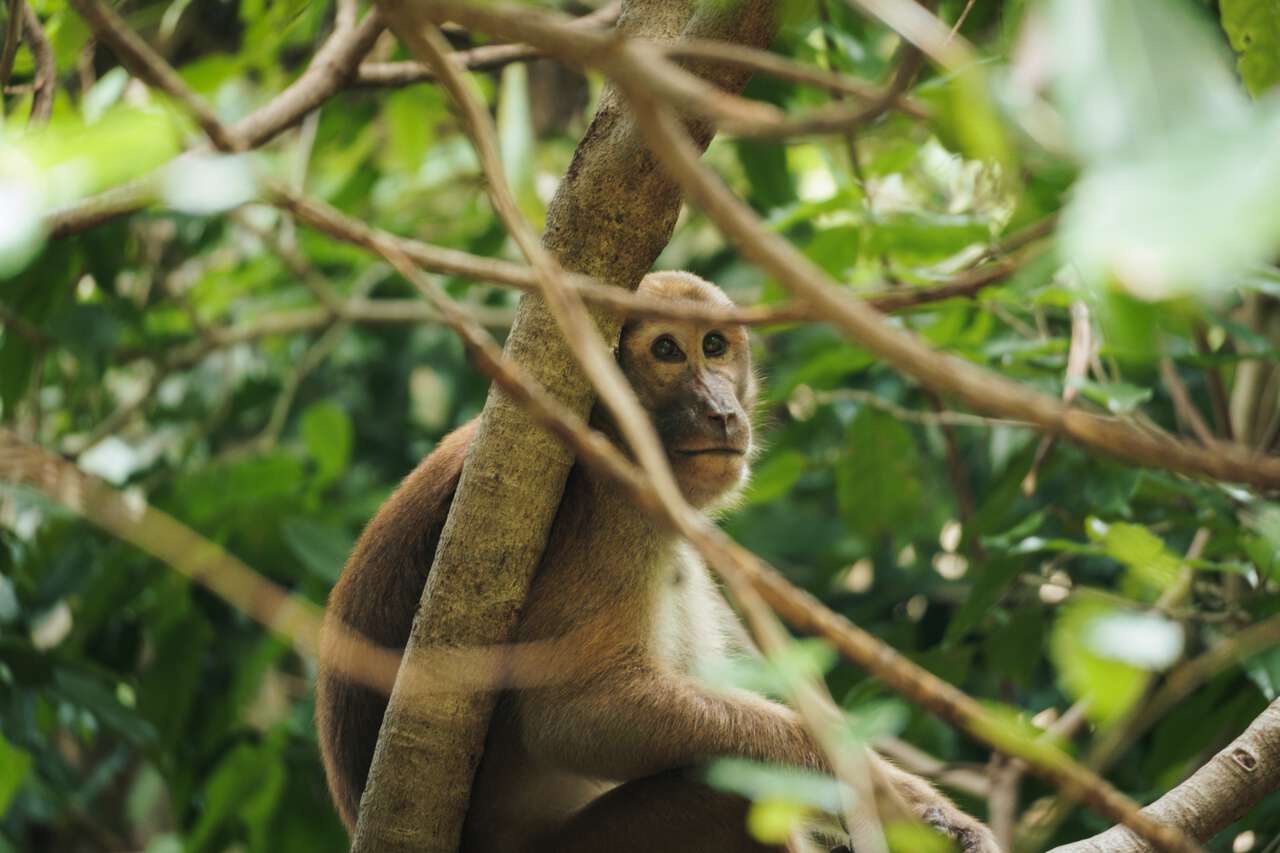
I can also use this lens to shoot wildlife, which I sometimes encounter while hiking in the mountains, without startling them away. I just wish I had this lens back when I was in Kruger National Park doing a safari tour. Imagine all the photos I could have taken!
And not just that, with this lens, I was able to capture some really stunning candid moments of the locals when I was at the Mon Bridge in Sankhlaburi, Thailand, almost half a bridge away. Plus, with the 350mm focal length, the bokeh you get from it, even at an F6.3 aperture, is just beautiful, which leads to my next point.
The Stunning Creamy Bokeh at Its Narrowest End

I had always wondered why some photos are able to have their background thrown so beautifully that you can see the subtle round curvature of the lens in the bokeh area.

I thought I would need a very expensive lens to reproduce such an effect, but the first photos I took at 350mm showed me how much subject separation a long focal length can create. The look is not caused by focal length alone: subject distance, background distance, aperture, and lens rendering all play a role. Still, the 350mm end makes it much easier to isolate a subject against a soft background.

The bokeh and subject separation of this lens allow me to create such a unique look in my photography that I had never been able to achieve before. It has opened me up to so many opportunities for experimentation with my travel photography. You can expect to see more unique-looking photos in my future travel guides 😉.
Easy to Travel With

Although the Sony E 70-350mm F4.5-6.3 lens is larger than any of the lenses I was carrying, it is actually not as difficult to travel with as it may initially seem. The dimensions fit perfectly well within my medium-sized camera compartment, and the lens is light enough for me to hang it from my neck without discomfort.
I can't say the same for other super-telephoto lenses out there. Have you seen that beast of a lens that the Sony full-frame camera owners have to carry? I'd take this lens with me on my travels over any other full-frame lenses any day.
A Delight to Handle and Use

It is such a delight to handle and use the Sony E 70-350mm F4.5-6.3 lens. The weight is not too heavy, the build is sturdy, and the focus and zoom rings are smooth and buttery. It also has a zoom ring lock button to prevent zoom creep, a hold-to-lock-focus button, and 2 switches to turn autofocus and stabilization on and off.
That said, I did have to get used to having the zoom ring in front of the focus ring, which none of the lenses I own have. However, I do understand why they did it this way from a design point of view.
The Drawbacks of the Sony E 70-350mm F4.5-6.3 Lens
Slow Aperture, Not Great in Low-Light

One of the greatest drawbacks of the Sony E 70-350mm F4.5-6.3 lens, and maybe a dealbreaker to some, is its slow aperture speed. At a 70mm focal length, the aperture will be set to F4.5, which is not so great already. However, when you increase the focal length to 350mm, the aperture creeps to F6.3. This is where you will start to see the limitation of this lens.
With such a slow aperture, you will have trouble capturing a sharp photo of wildlife in a thick forest on an overcast day, as there will be very little light to accommodate the slow aperture. Your camera might need to increase its ISO, resulting in noisier images.
I understand why Sony didn't build this lens to have a faster aperture. To do so, they would have to increase the size, weight, and price point, which, in my opinion, defeats the purpose of this lens.
Without its lightweight, compactness, and reasonable price point, people would probably go with the full-frame lenses instead. It is just a sacrifice we have to make to have a super-telephoto lens that is affordable and lightweight. Sony can't please us all.
Sample Images from the Sony E 70-350mm F4.5-6.3 Lens

Shot with Sony a6500 and Sony 70-350mm Lens at 70mm, F5, ISO 100, 1/200th shutter speed in Sangkhlaburi, Thailand

Shot with Sony a6500 and Sony 70-350mm Lens at 255mm, F6.3, ISO 500, 1/400th shutter speed in Sangkhlaburi, Thailand

Shot with Sony a6500 and Sony 70-350mm Lens at 350mm, F6.3, ISO 640, 1/500th shutter speed in Sangkhlaburi, Thailand
Shot with Sony a6500 and 70-350mm Lens at 350mm, F6.3, ISO 640, 1/500th shutter speed in Sangkhlaburi, Thailand. Look at the bokeh!

Shot with Sony a6500 and 70-350mm Lens at 350mm, F6.3, ISO 1600, 1/250th shutter speed in Sangkhlaburi, Thailand

Shot with Sony a6500 and 70-350mm Lens at 200mm, F6.3, ISO 160, 1/320th shutter speed in Sangkhlaburi, Thailand

Shot with Sony a6500 and 70-350mm Lens at 284mm, F6.3, ISO 640, 1/500th shutter speed in Bangkok, Thailand

Overall, This Is an Easy Recommend For Sony APS-C Camera Users

All in all, if you are looking for a long telephoto zoom for a Sony APS-C camera and prioritize reach, image quality, and portability, the Sony E 70-350mm F4.5-6.3 lens remains an easy lens for me to recommend. It was one of the best purchases I made for my APS-C travel kit, and the sample photos above show why I enjoyed using it so much.
Even if you think you do not need a telephoto lens when you travel, just look at all the sample photos I took above and see how different they all are from the photos in my previous travel guides. Think of all the possibilities you will have with such a reach that is not possible with any other lens of this size.
The lens is great for portraits, allowing you to capture candid moments of locals when you travel; it's also great for landscapes, allowing you to be minimal and frame your shot as you like. Finally, it's great for wildlife, allowing you to capture animals and birds without startling them.
The lens originally launched at $999 USD, but its current street price varies by retailer and promotion. Used copies can also be considerably cheaper depending on condition. Hit the link below to check the latest price of the Sony 70-350mm F4.5-6.3 lens.

Disclaimer: This post may contain affiliate links. See our disclosure policy.
First Published:


2 Comments
Would you buy this lens in 2023?
If I were on the APS-C system and looking for a lightweight telephoto, definitely. I love the bokeh coming out of this lens. :) I don't see the same effect on the Tamron 70-300mm.