



Taiwan is by far one of the most functional yet affordable countries I have ever visited. With the blend of influences between Japanese hyper-modernity, Chinese savviness, Southeast Asian affordability, and its own nature and mountains that rival no one, Taiwan really is a whole package of a destination a traveler like us could ask for.
I had a chance to backpack around the island from north to south and back for 15 days, exploring all the wonderful places Taiwan has to offer from Taipei to Kenting. Within this itinerary, I will highlight all the awesome places you should not miss when you are in Taiwan. Without further ado, let's begin with an overview of a 2-week itinerary in Taiwan.
Map of this 2-Week Taiwan Itinerary
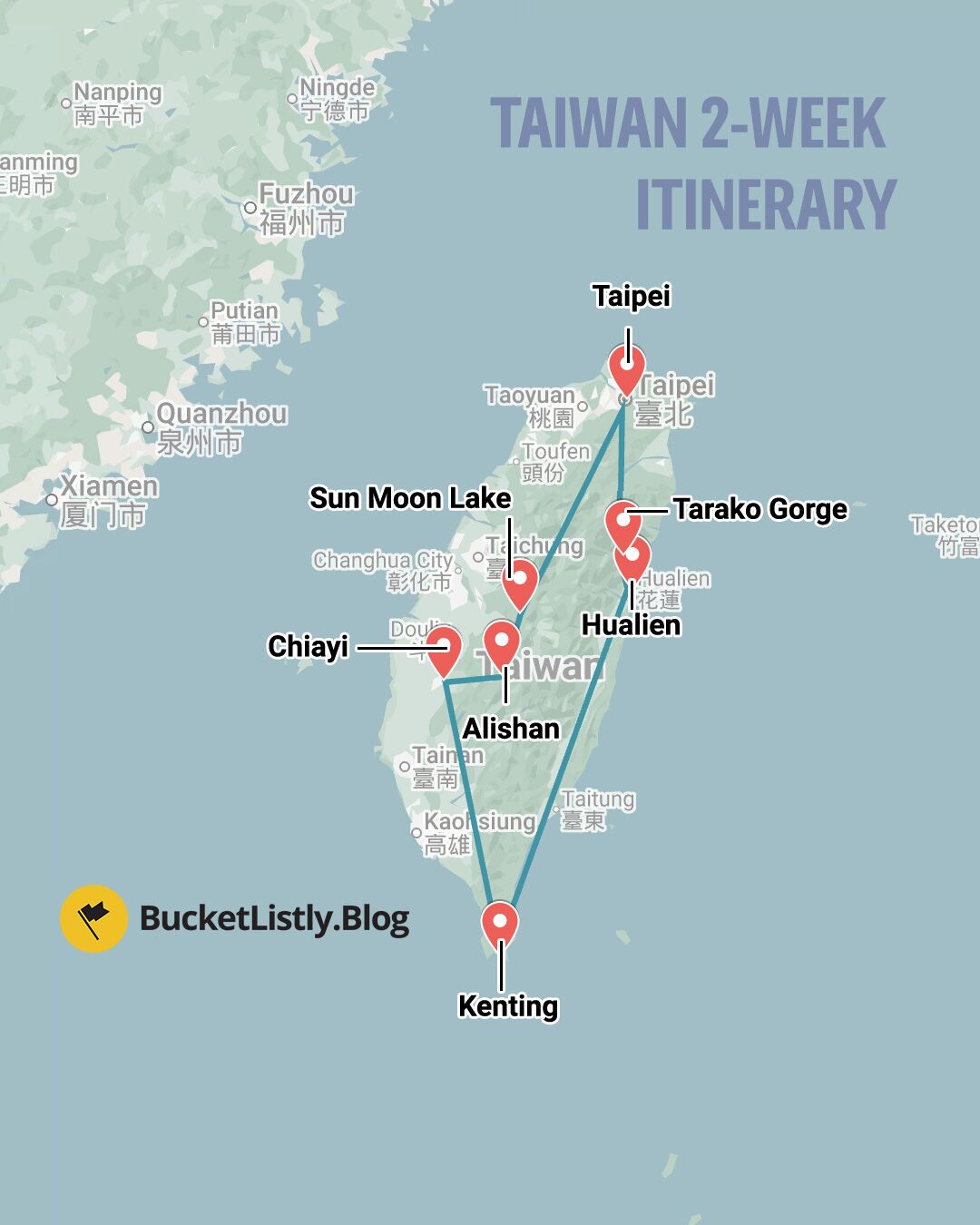
Quick Summary
| ☀️ Day 1-4: | Taipei |
|---|---|
| ☀️ Day 5-6: | Hualien & Taroko Gorge |
| ☀️ Day 7-8: | Kenting |
| ☀️ Day 9-10: | Chiayi & Alishan |
| ☀️ Day 11-12: | Sun Moon Lake |
| ☀️ Day 13: | Taipei |
2 Weeks Taiwan Itinerary
Day 1 - 4: Taipei (5 Nights)

- 📍 Stay: Meander Taipei Hostel - Ximending
- 🕐 Time: 5 Nights
- 📖 Full Guide: The Ultimate Backpacking Guide To Taipei
Taipei, an extremely modern city, yet affordable and accessible to all types of travelers, is where our journey begins. Taipei is one of those cities that maintains its tradition while also adopting a fun and colorful culture in parallel. Our journey begins with exploring all the cool attractions in the city, starting with the Longshan Temple.

Longshan Temple is a Chinese temple built in the 18th century by Fujian immigrants from mainland China who came to the island and erected a temple on the spot. It is one of the most popular temples in Taiwan and has come to represent the pride of the Taiwanese people.

Spend a few hours there admiring the beauty of the temple before continuing on to explore other parts of Taipei, such as Chiang Kai-Shek Memorial Hall, where you will find a spacious courtyard, beautiful vegetation all around, and some stunning architecture like the Memorial Hall itself and the Liberty Square Arch.
- One-Day Private Guided Tour in Taroko Gorge from Hualien (8 hours)
- 8-Hour Private Taipei Day Tour: PLANLESS (8 hours)
- Small-Group Tour: Jiufen, Yehliu Geopark, and Shifen from Taipei (9 hours)

The National Chiang Kai-shek Memorial Hall is also a great place to watch the sunset over the city, as the elevated platform of the memorial hall will allow you to see the expansive view of Liberty Square.

Also, be sure to drop by there around 6 PM to witness the Flag Coming Down Ceremony, as the guards march down the hall and to the flag pole at the center of Liberty Square, performing the Flag Coming Down Ceremony.

After the sunset, hop on an MRT and visit Ximending Street, one of the most popular shopping districts in Taipei. The entire neighborhood is filled with stores, street food stalls, and all kinds of entertainment you could imagine.

I would recommend that you visit Ximending at night, as it becomes much more active than during the day. The streets are full of performers and street food stalls (some of which may be illegal) for you to enjoy.

While you are there, also be sure to drop by The Red House, a beautiful western-style but Japanese-built department store turned creative marketplace that is promoting the locals' artistry and other cultural industries.

For your second day, you can venture out of the central area a bit and visit Taipei 101, a futuristic skyscraper with 101 floors standing at a height of 509.2 m. It is one of the most iconic landmarks in the city.

The standard adult ticket to the Taipei 101 Observatory is still 600 TWD in 2026 and includes access to the 88th and 89th floors. One of the highlights is its massive 660-ton tuned mass damper, which helps stabilize the tower during strong winds and earthquakes.

If you are not keen on paying 600 TWD to get a view of the city, the best alternative is to go a little further east and hike the famous Elephant Trail for a stunning view of Taipei 101 and the nightly cityscape of Taipei, free of charge!

If you are looking for a night market, I highly recommend you visit Ningxia Night Market around 6 PM. The night market will be extremely crowded during this time, and the street food stalls are in full swing, which makes it even more fun to walk around and eat your way through it.


For your third day, you can hop on a bus and go and explore the wild nature of Yangmingshan National Park, which is home to Xiaoyoukeng Recreation Area, a post-volcanic geological landscape area with a few scenic trails you can do, Qixingshan (Seven Star Mountain) Trail, a 5.7 km long hiking trail that will take you to the top of Qixingshan Main Peak, and Erziping, a recreational area full of forest and mountains, and many others.

On your fourth day, we are going to go out of Taipei a bit and explore the beautiful town of Shifen, followed by a walk along the Spirited Away-inspired old streets of Jiufen.

What is there in Shifen, you asked? Well, Shifen Waterfall, of course, which is considered to be one of the most scenic waterfalls in Taiwan. Its beautiful sheet of water flows down a 40m height rockface, creating a fog that helps mystify the forest around it.

Shifen is also known for its floating lanterns that were used during the civil war by protectors of the city to signal people who ran away into the forest that it is now safe to return.

Nowadays, most people will write their wishes down onto the lantern, snap the iconic photo with the lantern on a train track, and set the floating lantern free, in hopes that the wish will come true. It is a fun activity to do with friends in Shifen.

To get from Taipei to Shifen, you will have to take a train to Ruifang. Once you arrive, you will need to transfer to a Pingxi line, and the train should stop at Shifen.

After half a day in Shifen, hop on a train back to Ruifang and take bus #960 or #788 from Ruifang Industrial Vocational High School bus stop to Jiufen.

Jiufen is a decommissioned gold mine town located on a mountain by the seaside north of Taipei. The town is now known for its night markets full of delicious food to try, the maze of small lanes and alleyways full of history, and the beautiful A-MEI Tea House that inspired some scenes in the movie Spirited Away.

Jiufen Old Town is best visited during the late afternoon, around 4 - 5 PM, as the streets are still relatively empty and the restaurants and tea houses are opening. At about 6 PM, it can get so crowded that you might not be able to move for 15 minutes at certain intersections.

After spending 4 days exploring Taipei, it is time to move on to our next destination, which is one of the most popular tourist attractions in the country: Taroko Gorge and Hualien City, where we will be basing ourselves from.


Getting from Taipei to Hualien
There are several ways you can travel from Taipei to Hualien, but the easiest, most convenient way is to take the express train (TRA) from Taipei Main Station to Hualien Railway Station.
The fastest direct TRA services from Taipei to Hualien generally take around 2 to 2.5 hours, depending on the train. There is no HSR service to Hualien, since Taiwan High Speed Rail runs along the west side of the island. For this route, book one of TRA's reserved express services, especially on weekends and holidays when seats to Hualien can sell out.
For the train schedule from Taipei to Hualien or if you want to book online, be sure to check out: The Official TRA Ticket Information and Timetable.
Day 5 - 6: Hualien & Taroko Gorge (2 Nights)

- 📍 Stay: Art Zone 2
- 🕐 Time: 2 Nights
- 📖 Full Guide: The Ultimate Backpacking Guide For Taroko Gorge
After 4 days in Taipei, continue east to Hualien, the gateway to Taroko National Park. Important 2026 update: Taroko is still recovering from the April 2024 earthquake, and access remains very different from when I made this trip. Some mountain routes have reopened, but several of the gorge's famous visitor areas and trails are still affected by reconstruction, road controls, or closures. Check the latest Taroko National Park and Provincial Highway 8 notices immediately before visiting.

Taroko Gorge, the stunning 18 km long canyon with the pristine blue Liwu River running through it, is Taiwan's most well-known and celebrated tourist attraction in the country, and for good reason.

When I visited, I based myself in Hualien and used the buses from Hualien Station to spend a full day hopping between stops in Taroko Gorge. Do not rely on the old bus-schedule image above for a 2026 trip. Highway 8 continues to operate with post-earthquake traffic controls in parts of the gorge, and public transport access can change along with road conditions and reconstruction work.

On my trip, Taroko Gorge was packed with dramatic scenery, tunnels, and hiking trails. One of my favorites was the Baiyang Trail, which took me to Baiyang Waterfall and the Water Curtain Cave. Because trail conditions have changed significantly since the 2024 earthquake, treat the trail descriptions in this section as a record of my visit and confirm what is actually open before setting out. Last I heard, this part was still closed.

Another highlight from my visit was the Tunnel of Nine Turns, where a short walking route followed the gorge through a spectacular section of exposed marble cliffs. Access in the gorge is now dependent on reconstruction and road conditions, and last I checked you can see the tunnel and the gorge, but you can't access it at the moment.

Another impressive walk I did was the Swallow Grotto Trail (Yanzikou Trail), which runs through one of the narrowest and most dramatic sections of the Liwu River Gorge. Again, this trail remains closed based on the last time I checked in 2026.

Other places I visited or recommended around the gorge included the Changchun Shrine (Eternal Spring Shrine), Zhuilu Old Trail, and the Lushui area. As of September 2026, Zhuilu Old Road has not yet reopened following the earthquake. Conditions elsewhere in the gorge remain changeable, so check the national park's latest closure notices before your trip.


Getting from Hualien to Kenting
From Hualien, you can take the regular train from Hualien Station to Fangliao Station (one of the stops of the Kenting Express Bus), where you can then catch the Kenting Express Bus to Kenting National Park.

After arriving at Fangliao Station, you will have to walk out to the main road and wait for the Kenting Bus at the Fangliao Station Bus Stop, and you should be on your way in 30 minutes. From Fangliao to Kenting, the journey should take about 1 hour, depending on the traffic.

The Kenting Express 9189 connects THSR Zuoying Station with Kenting, stopping at places such as Fangliao, Hengchun, Nanwan, and Kenting along the way. The current scheduled journey is around 140 minutes, and the official one-way fare from Zuoying to Kenting is 401 TWD. If you pay with EasyCard or another electronic fare card from Zuoying, stop by the Kenting Express counter first to get a seat-reservation card, since standing passengers are not allowed on the expressway.
Day 7 - 8: Kenting (2 Nights)

- 📍 Stay: Kenting Peninsula Inn
- 🕐 Time: 2 Nights
- 📖 Full Guide: 9 Best Things To Do In Kenting
Kenting is a great place to take your mind off what you've come to expect from Taiwan. The town is located all the way at the southern tip of Taiwan, surrounded by pristine beaches, beautiful coastlines, and a warmer climate. With such a drastic difference from Taipei and Hualien, you may start to wonder if you're actually in Taiwan.

First and foremost, on your first day in Kenting, rent an e-scooter, go out, and explore the coastline east of Kenting. Places like Longpan Park and Fengchuisha are great places to begin your day, with a stroll along the coastline. Keep in mind, though, that the southern coastline of Taiwan sees extreme wind all year round, so be sure not to stand off a cliff.

You can also visit the Taiwan Southernmost Point Monument and take a photo to commemorate the fact that you have finally traveled from the north all the way to the south of Taiwan.

Another place I would recommend you stop by is Eluanbi Park. Within the park, there are several walking trails you can take. Some go through an open-air museum showing what the life of the indigenous people was like, while others take you to stunning viewpoints. All of them are worth visiting, so be sure to spend some time in the park.

Now that we have explored east of Kenting, it's time to go to the west. With your e-scooter, travel along the main road past Kenting Town and visit Maobitou Park for an epic view of the beautiful black limestone coastline, and lay down in the sun at White Sand Bay for the rest of the day.

Be sure to come back in time for you to return the scooter and enjoy all the awesome food at Kenting Night Market along the main road before ending your day in Kenting.

Where to Stay in Kenting?


Getting from Kenting to Chiayi
From Kenting, take the Kenting Express 9189 back to THSR Zuoying Station, then continue north by high-speed rail to Chiayi. The THSR ride takes roughly 30 minutes on many services, and the current standard reserved-seat fare between Zuoying and Chiayi is 410 TWD, with a slightly cheaper non-reserved option.
Day 9 - 10: Chiayi & Alishan (2 Nights)

- 📍 Stay: Chiayi King Hotel
- 🕐 Time: 2 Nights
- 📖 Full Guide: The Ultimate Backpacking Guide To Alishan
After arriving in Chiayi, you can spend that evening exploring the city and checking out the Song Of The Forest, Hinoki Japanese Village, and Alishan Forest Railway Garage Park before heading over to Wenhua Road Night Market for a feast. This way, you can end the day and start early the next day to go to Alishan.

Alishan National Park is a 415 square kilometers nature reserve full of mystical-looking forest and tons of things waiting for you to explore. From taking the Old Alishan Forest Rails to hiking up mountains to witness the sea of clouds, here is a complete backpacking guide on things to do in Alishan National Park as well as cool things to do in Chiayi.

There are a ton of beautiful trees and several walking and hiking trails that will take you to see some of the largest and oldest cypresses you will ever see in Alishan.

The Giant Trees Broadwalk is a walking path that will take you through zig-zag trails that go around the Alishan forest, allowing you to enjoy the view while strolling safely on a wooden platform.

The trail will pass the No.28 Giant Tree, the Taiwanese Cypress that stands at 43.5m with a trunk circumference of 13.1m. It is estimated that the tree is over 2000 years old.

There are also 2 temples I recommend you visit: the Japanese-built Cihyun Temple with a great view of the sea of clouds, and Shouzhen Temple, the largest temple in Alishan and the highest in terms of elevation in Taiwan.

They both showcase the mastery of craftsmanship of the people who built these temples during the Japanese period. There are also several food stalls around Shouzhen Temple, making it a great place to stop for lunch before continuing.

Another place I would recommend you to check out is Sister Ponds, one of the most photogenic places in Alishan with the saddest story ever!

Apparently, the story goes that the two sisters fell in love with the same man and, not wanting to betray the sisterhood, both decided to jump into each pond and end their lives. Hence, one pond is called the Elder Sister Pond and the other is called the Younger Sister Pond.

If you like hiking, I would also recommend you to go hike the Zhushan Sunrise Hiking Trail for a grand view of Jade Mountain (Yushan), the highest mountain in Taiwan, and hike to Tashan Peak to witness the sea of clouds.

The Tashan Mountain Trail is particularly my favorite. It is a hiking trail that will take you along the railroads before ascending mountains to the top of Tashan Peak, where you will be able to witness the Sea of Clouds and enjoy Alishan in solitude.

The hike should take about 2.5 hours roundtrip, with a flat trail for 2 km, and then it shoots steeply up to the peak for about 1.7 km. You should be a bit in shape if you wish to hike up to Tashan. It's not hard; it's just steep in the last part.

Once at the top, you should be able to see Tashan Peak from the viewing platform. And if you're lucky, like I was, you might be able to see the sea of clouds in Alishan that everyone has been raving about.

If you are hiking Tashan as a day trip from Chiayi, keep a close eye on the return bus schedule. The timetable changes, so confirm the final Alishan-to-Chiayi departure on the day you travel and leave yourself plenty of time to get back to the bus stop. Missing the final bus can leave you with an expensive taxi ride or an unplanned night in Alishan. When I was there, the bus left around 5:05 PM, but I'd say be there a few hours earlier, just to be sure.

Where to Stay in Chiayi?


Getting from Chiayi to Sun Moon Lake
From Chiayi to Sun Moon Lake, you can take the normal train (TRA) from Chiayi Station to Taichung Station. The train journey from Chiayi to Taichung takes about one hour and costs 240 TND.

After you arrive in Taichung, you can once again catch Nantou Bus #6670 from Taichung Station Bus Stop, and you should reach Sun Moon Lake in 1.5 hours.
To book the train from Chiayi to Taichung, be sure to check out: The Official TRA Booking and Timetable.
Day 11 - 12: Sun Moon Lake (2 Nights)

- 📍 Stay: Timing House B&B
- 🕐 Time: 2 Nights
- 📖 Full Guide: The Ultimate Backpacking Guide To Sun Moon Lake
Sun Moon Lake, one of the most popular tourist attractions in Taiwan, offers vistas of rolling hills and mountains, with a beautiful calm lake in the foreground. It also contains pockets of rich indigenous culture, all waiting for you to explore.

On the day of your arrival, after settling into your accommodation, I would recommend that you go for a little walk along the Hanbi trail, a small trail off Shuishe Pier that hugs along the lakeside and ends at Yule Pavilion, for a beautiful sunset before resting for the rest of the day.

If you don't mind waking up early, I highly recommend that you wake up early and watch the sunrise at Shuishe Pier and walk by Meihe Park the next day.

After sunrise, go and find a bike shop, which shouldn't be difficult as there are tons of them on the main road in Shuishe, and rent a bike to explore the surroundings.

Take the bike path that goes along the lakeside, down through some of the most stunning viewpoints at Sun Moon Lake like Longfeng Temple and Xiangshan Scenic Outlook, all the way to the Northwest Observation Platform.

I've gotta admit, this is probably one of the most delightful bike paths I have ever experienced. The scenery along the bike path was amazing, and with a bike, you can stop and take a picture anytime you like.

After spending half a day exploring Sun Moon Lake with a bike, it is time to go further and check out all the cool temples in the mountains. I would recommend you take the round-the-lake bus instead, as the road gets quite hilly.

Take the #6669 bus from Sun Moon Lake Bus Stop and get off at Wenwu Temple Bus Stop, and you will be right in front of our next destination, the massive Wenwu Temple.

Wenwu Temple is a grand Chinese-style temple located atop a hill with a stunning vista of Sun Moon Lake and all its mountains. The temple consists of 3 halls dedicated to 3 different gods. There is also a large marble pillar built atop the park above Wenwu Temple which you should not miss.

After visiting Wenwu Temple, hop on another bus and make your way to Ita Thao on the other side of the lake. Indulge in all of its street food at Ita Thao Shopping District.

After eating at Ita Thao, hop on another bus to Xuanzang Temple and hike up to Ci'en Pagoda for the most incredible view of Sun Moon Lake.

Ci'en Pagoda is a 48-meter-tall Chinese-style pagoda located atop a mountain, where one can climb to the top and enjoy a panoramic view of the lake.

The Pagoda closes at 16:30, so be sure to calculate your arrival time as well as the time it takes for you to hike 400 steps. This should take about 10-20 minutes, depending on your fitness level, so that you can arrive before it closes.

After visiting Ci'en Pagoda, take the bus back to Shuishe, get your bike, and ride to Shuishe Dam for a beautiful sunset before ending your incredible adventure at Sun Moon Lake.

Where to Stay in Sun Moon Lake?


Getting from Sun Moon Lake to Taipei

From Sun Moon Lake, you can take Bus #1833 from the bus stop in front of the Tourist Information. It leaves 6 - 8 times a day from 7:30 to 16:20 every day. The journey should cost around 420 TWD per person, and you should arrive at Taipei Main Station in 4 hours.
Taipei (1 Night)

Congratulations, you have traveled around Taiwan for 2 weeks. You deserve a good rest in Taipei, but if you still haven't had enough awesome photos from Taipei, I know the best place to capture the iconic Taipei 101.

One of the best photo spots in Taipei is at the Lane 253, Songren Road in Xinyi District near the Takemura Izakaya restaurant. This is the street where you can capture the iconic Taipei 101 between two buildings, creating the symmetrical art that you see above.
Taiwan Travel Video
When to Visit Taiwan?

The best time to visit Taiwan is from late October to April, when the temperature should hover around 17°C - 24°C in the lowland and a little bit chillier in the mountains. These are the best months to visit because the weather won't be too humid, and you are likely to get less rain during this time, which is a blessing and hard to come by on an island like Taiwan.
Since Taiwan is an island, rainfall is quite common and expected to be unpredictable, even during the recommended timeframe. So, prepare an umbrella or a rain jacket when visiting Taiwan.
Taiwan is also prone to typhoons, and I would highly recommend that you avoid visiting from June to September, as the wind can be extremely violent. These typhoons may cause many tourist attractions to go on lockdown, preventing you from enjoying the outdoor activities that Taiwan is known for.
How to Get to Taiwan?
Most of the flights coming to Taiwan will arrive at Taoyuan International Airport in Taipei, and depending on where you are, there are several airlines you can fly with to Taipei.
From the US, there are several direct flights from big cities like New York and LA via United Airlines. Alternatively, you can also fly directly to Taipei via EVA Airlines, its national carrier.
From within Europe, you can also fly directly via EVA Airlines or popular carriers like KLM or AirFrance to Taipei. You can also fly via Asian airlines like Singapore Airlines or Thai Airways, but you will have to transit in their respective home countries.
From Asia, traveling to Taiwan becomes a lot easier and cheaper with several low-cost airlines operating this route from hub cities like Bangkok and Singapore. Lion Air, as well as AirAsia, have many flights flying from Bangkok/KL to Taipei every day, so you should have no problem finding one if you are planning to fly from Asia.
To find a cheap flight to Taipei, I would recommend you use Skyscanner or Expedia to look for the cheapest route and schedule so you can compare and choose the best one.
How to Get from Taipei Airport to the City Center?

From Taoyuan International Airport, there are two ways you can travel to the city: by bus and by the Metro. The easiest option is to take bus #1819 from outside the Airport Terminal 2, which will take you to Taipei Main Station.
By Bus
Bus #1819 runs 24 hours, operating every 15-20 minutes during the day and once every hour in the early mornings (2 AM - 5 AM). The ticket can be purchased at the ticket kiosk before exiting Terminal 2.
Simply follow the "Bus to City" sign until you find a line of ticket kiosks where you can then buy the ticket. The ticket should cost you around 125 TWD, and the journey from the airport to Taipei Main Station should take around an hour.
You can find an updated bus timetable for bus #1819 on their official website here: Bus #1819 Timetable.
By MRT
You can also take the MRT (Taipei's metro system) to the city via the MRT's purple line, straight to Taipei Main Station. However, it is often longer and a little less convenient, especially if you have a lot of luggage.
The Airport MRT costs 160 TWD between Taoyuan Airport and Taipei Main Station. Take an Express train if possible; it skips most stations and is much faster than the regular train. From Terminal 1, the current last Express train toward Taipei Main Station departs at 22:58, while later commuter service is also available. Always check the current timetable if your flight arrives late at night.
I highly recommend that you buy an EasyCard at the airport and use it to travel by metro or bus instead of buying individual tickets, as it will be more convenient for you in the long run. Read more about the EasyCard under the "Traveling Around Taipei with EasyCard" section below.
How to Get Around Taiwan?

Taiwan is probably one of the easiest countries to travel around. With the widely accepted IC card called EasyCard, you can get on a bus or a train with one simple gesture, and that's it. To understand how you can travel around Taiwan, first, you need to understand what EasyCard (or other IC card) is and how it will benefit your travel.
Getting Around Taiwan with EasyCard

One of the best things about Taiwan is how easy it is to travel around the country, thanks to the adoption of the IC (Integrated Circuit) card. This card makes getting around Taipei, as well as the rest of the country, such a breeze. Here's how it works:
EasyCard is a universal IC money card that can be used to pay for everything from buses to trains to groceries all over Taiwan. It makes traveling in Taiwan a whole lot easier for those of us who don't know Mandarin. I was able to travel the entire island on buses, trains, and metros just by using the EasyCard.

To travel around Taiwan with EasyCard, all you have to do is simply tap on the card reader machine when you get on and tap once again when you get off, and that's it. You have already paid for your transportation!

You can buy the EasyCard from the airport, any of the MRT stations in Taipei, or from any of the 7-11 or Family Mart convenience stores around the country.
The card should cost around 100 TWD, and you can then top up the card with more money from the ticket machines in all the MRT Metro Stations in Taipei or at 7-11 and Family Mart.
The amount of value deducted from the card will depend on the distance you have traveled, so be sure to have enough money on your EasyCard before the trip. Otherwise, you might have to buy the ticket directly from the bus driver instead.
Getting Around by Train

Taiwan has 2 train systems: the TRA, which operates regular and express trains, and the THSR, which operates high-speed trains. Generally, the TRA is slower but cheaper, while the THSR is faster but more expensive. Depending on your needs, you can choose whichever one of these trains fits with your schedule.
Do not treat TRA and THSR as interchangeable when using EasyCard. EasyCard is extremely useful on local public transport and can be used on eligible TRA services, but for THSR you should buy a high-speed rail ticket or use one of THSR's supported ticketing methods rather than assuming you can simply tap through the gates in the same way.
Keep in mind, though, that you won't be able to book seats with this method, so you will have to risk it or stand. I would recommend using EasyCard for shorter trips, such as going to Jiufen from Taipei, etc.
For longer trips, I would recommend you book a train ticket through their mobile applications. Keep in mind that the THSR and TRA often have their own train stations, so be sure you are arriving at the right one.

For TRA, you can download the app from Apple Store/Google Play and you can buy a ticket with a credit card. The app can be switched to English, but some notifications are often in Chinese. Therefore, you would either have to translate them one by one or ignore them, which oftentimes works.
Once you have bought a ticket from the app, you will also have to collect it through the app within 2 days (including the booking date) before it gets automatically canceled. If you book on the day you are traveling, you have to collect it 30 minutes before the departure time.
One phone can collect one ticket, so if you bought 2, make sure that the other party has the app and collects the ticket individually, so you can use your phone to enter the platform.
Once you collect your ticket, all you have to do is open the ticket with the QR code and let the machine scan the QR code to enter the platform, similar to how EasyCard works. You have to do the same on your way out as well.
For more information on schedules and booking, be sure to visit The Official TRA Booking Website.
For THSR, it is pretty much the same as TRA with the app. You must first download the THSR app on Apple Store/Google Play, and from there, you can buy tickets with your credit card. Click "Collect & Distribute" to collect your tickets, and then you can use the ticket with the QR code on your phone to get access to the platform.
For more information on schedules and booking, be sure to visit The Official THSR Booking Website or you can book it through 12GO.com.
You can pretty much reach almost everywhere in this itinerary by train, but sometimes, you are better off taking a direct bus instead.
Getting Around by Bus

Buses are a great way to get around Taiwan, especially when going from a city to a nature spot like Alishan and Taroko Gorge, where train access is limited. Buses are also a great way to navigate cities like Taipei, Hualien, and Chiayi, especially when it comes to reaching places where the MRT doesn't go.
With EasyCard, all you have to do is get on the right bus, tap the card reader when you enter, and once again when you get off, and the money will be deducted from the card. That's it. If you do not have an EasyCard, you will have to prepare the exact amount in cash as bus drivers often don't have change.
To find the right bus to take, you can use Google Maps and enter the destination you want to visit. The app will suggest which bus number you should take. This works 90% of the time, with 10% showing the correct bus but not all the available options. This could be due to seasonal schedule changes from bus operators.
For more information on schedules and booking for buses, check out: Book Buses in Taiwan.
How Much Money Do I Need For Taiwan?
For this 2-week itinerary, I would now budget roughly 20,000 - 30,000 TWD per person as a practical backpacker starting point, excluding your international flight. Taiwan is still excellent value, but accommodation, food, and transport costs are higher than when I first wrote this guide.
Accommodation: For 14 nights, a realistic budget-travel allowance is around 8,000 - 12,000 TWD if you book hostels and inexpensive stays.
Food: Night markets, local restaurants, convenience stores, and inexpensive noodle or rice shops make Taiwan easy to do on a budget. Allow roughly 400 - 700 TWD per day, or about 5,600 - 9,800 TWD for two weeks.
Transportation: This itinerary covers a large part of the island and mixes TRA trains, THSR, long-distance buses, and local transport. I would set aside around 4,000 - 6,000 TWD, depending on which train classes you use and how many side trips you take.
Activities: Many temples, hikes, markets, and outdoor attractions are free, but paid sights such as Taipei 101 and Alishan add up. Allow at least 1,000 - 2,000 TWD for sightseeing, with extra room if you book tours or paid activities.
Total Budget for 2 Weeks in Taiwan: 20,000 - 30,000 TWD per person (630 - 945 USD)
Is it Safe in Taiwan?
Taiwan is prone to typhoons, and as I wrote earlier, please avoid visiting Taiwan during the typhoon season (June - September). That is when you are likely to encounter rain and thunderstorms, which increase the risk of natural disasters. You would not want to be exploring places like Taroko Gorge when that happens.
Other than that, Taiwan is probably one of the safest countries I've been to so far. You are unlikely to encounter any scammers, catcallers, or pickpockets in any of the cities you are visiting in Taiwan. That said, it is best that you exercise precautions like keeping your belongings with you, just as you would when visiting any other big cities.
Which tourist SIM card is best for Taiwan?
Taiwan has one of the fastest public WIFI networks out there. Most of the hostels and restaurants I visited in Taiwan had fast, reliable WIFI, so you could get by without having a local sim card. However, if you wish to navigate the city by bus, I recommend getting a local sim card at the airport upon your arrival.

I recommend Chunghwa Telecom, one of Taiwan's major carriers. Its current tourist prepaid lineup still includes unlimited-data 4G plans, ranging from 300 TWD for 3 or 5 days up to 1,000 TWD for 30 days. There are also 5G tourist plans if you want faster service.

You can find their kiosk among other carriers at the arrival hall at Taoyuan International Airport in Taipei. Simply approach them, and they will show you the list of packages available that you can choose from. They will ask for your passport, pop the SIM card in for you, and within 2 minutes, you will have unlimited 4G data for your Taiwan trip.
I had 15 days in Taiwan, so I bought Chunghwa's 15-day unlimited-data SIM and had a 4G connection everywhere I went. Conveniently, that same 15-day 4G tourist plan still costs 700 TWD in 2026 and includes 100 TWD of domestic voice credit. If you want a physical local SIM, picking one up at the airport remains one of the easiest options.
Alternatively, if your phone supports eSIMs, you can set one up before arriving and have mobile data as soon as you land. You can browse through available eSIMs here.
For more information about Taiwan's local SIM card: Taiwan Prepaid Data SIM Card.
Tips: To stay connected with people at home, be sure that you have a VPN, such as ProtonVPN, installed before traveling. It's FREE, and you can gain access to services that may be blocked in certain countries.
Disclaimer: This post may contain affiliate links. See our disclosure policy.
First Published:
Last updated:
2 Comments
WoW!! after Reading your post about Taiwan, I felt like I was there with you. Honestly you have given me the motivation to travel there. Thank you and I am so happy that I have found your blog. I will ow be following it for more of your travels.
Thank you for the comments! Taiwan is definitely an awesome place to travel too especially if you enjoy street food, and who doesn't? :) Highly recommended!